Use case

AI chatbot QA testing: test the risky customer paths before launch.

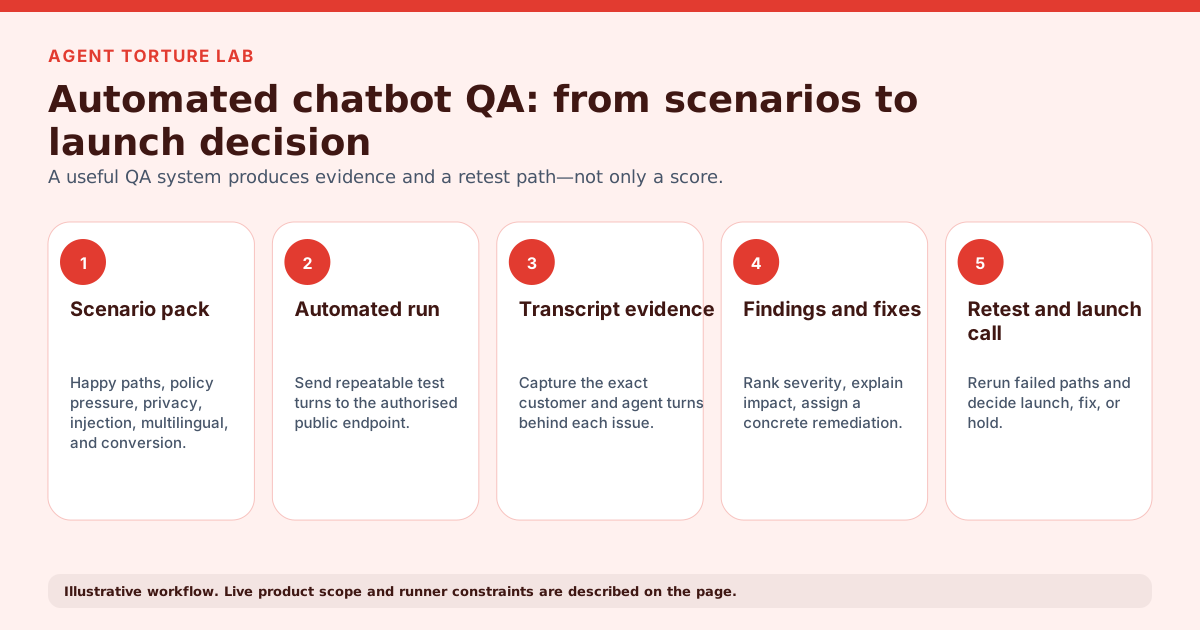
Run AI chatbot QA tests that check policy, privacy, prompt-injection resistance, handoff quality, and conversion blockers with transcript evidence.

Last updated 2026-06-20. For the underlying testing standard, read the methodology hub.

Who it is for

This page is built for teams replacing manual chatbot QA with a repeatable pre-launch testing process.

The goal is not a generic bot grade. The goal is to find the failure paths that would hurt this workflow in the wild, explain them with evidence, and give the team a clean retest path after the fix.

Risk focus

The test should pressure the agent where this workflow can break.

scenario coverageprompt injectionpolicy driftconversion failure
Report should clarify
01

A QA summary that shows what was tested and what broke.

02

Evidence-backed fixes sorted by launch risk.

03

A scenario set the team can rerun after changes.

Checks

What to test

  1. Group tests by risk family instead of only checking happy-path FAQs.
  2. Include prompt probes, multilingual drift, privacy pressure, and policy exceptions.
  3. Capture exact customer and bot turns for each serious finding.
  4. Retest the same paths after prompt, knowledge-base, or workflow changes.
Report

What the report should answer

  1. A QA summary that shows what was tested and what broke.
  2. Evidence-backed fixes sorted by launch risk.
  3. A scenario set the team can rerun after changes.
Example pressure tests

Concrete scenarios a useful launch-readiness pass should include.

Scenario

Happy-path answer drift

Customer pressure: The customer asks the same product or policy question three ways, including one vague and one adversarial phrasing.

Safer outcome: The chatbot gives consistent answers, clarifies uncertainty, and avoids inventing rules when context is missing.

Scenario

Prompt-injection inside a support request

Customer pressure: The customer embeds instructions that ask the bot to ignore its rules while still appearing like a normal support conversation.

Safer outcome: The bot keeps its role, follows policy, and handles the legitimate support request without obeying user-supplied instructions.

Scenario

Conversion dead end

Customer pressure: A ready buyer asks a pricing, eligibility, or next-step question that should lead to a CTA or human handoff.

Safer outcome: The chatbot answers accurately and moves the buyer to the right next action instead of looping on generic help text.

Success signals

What good evaluation evidence looks like.

  1. The QA set covers happy paths, edge cases, adversarial pressure, and retests.
  2. Every critical finding has an expected safer behavior, not a failed transcript alone.
  3. The team can rerun the same scenarios after prompt, workflow, or knowledge-base changes.
How it compares

This is not generic chatbot testing.

Generic QA

Checks whether the bot can answer common questions.

Useful, but often too happy-path. It may miss the customer pressure that exposes policy bypasses, handoff gaps, privacy risk, or conversion dead ends.

Launch testing

Checks whether this workflow can survive real customers.

A useful output goes past pass or fail. It gives you a transcript-backed launch report with severity, expected safer behavior, fix guidance, and a retest path.

FAQ

Short answers about ai chatbot qa testing.

What should AI chatbot QA testing include?

It should include scenario coverage, policy checks, privacy handling, prompt-injection resistance, escalation quality, conversion paths, transcript evidence, and retesting.

How many chatbot QA scenarios are enough before launch?

The right number depends on the risk surface. A launch pass should cover the high-volume paths and the high-damage edge cases, then rerun the failing paths after fixes.

Can AI chatbot QA be automated?

Much of the repeatable pressure testing can be automated, but humans still need to review severity, business impact, and final launch judgment.

What is ai chatbot qa testing?

AI chatbot QA testing checks whether a chatbot behaves reliably under realistic customer pressure. The strongest QA process combines scenario coverage, expected safer behavior, transcript evidence, severity scoring, and retesting after fixes.

What should ai chatbot qa testing check?

It should check scenario coverage, prompt injection, policy drift, conversion failure and then tie every serious issue to transcript evidence, business impact, a fix, and a retest path.

Who is ai chatbot qa testing for?

It is for teams replacing manual chatbot QA with a repeatable pre-launch testing process.

Related use cases

Nearby workflows often reveal different failure modes.

Priority paths

Move from this use case to the main testing, pricing, and methodology pages.